

For Peter · First look · 30 September 2026
London: stay serviced, or sign a direct lease?
The situation. Harvey has about 300 desks in a serviced office in King’s Cross (Fora), with 12 to 18 months left on the deal. The team may grow to 500 or 700. You asked when that arrangement becomes more expensive or less effective than a lease, and what a lease would need up front.
Stay in serviced space for now, if the provider can guarantee room to grow. If it can’t, serviced space is a two-year bridge, and the search for something bigger starts straight away.
Based on local market knowledge, a ten-year direct lease only costs less per desk than serviced space if Harvey needs the space for the full ten years, and it needs about £7 million of fit-out (the build-out, in US terms) before anyone moves in. For 500 people growing at a steady pace, the cheapest counted option over 5 years is staying serviced (about £41 million), then a direct lease for today’s team with serviced desks for growth (about £42 million), then one direct lease for everyone (about £44 million). This assumes Harvey can keep adding serviced desks in King’s Cross as it grows. Supply there is extremely tight, so that is not assured; see section 6. This is indicative pricing based on local market knowledge: no quotes have been requested and no landlord or provider has been approached.
At a glance
What we’d do in each case.
The rule: if a direct lease can’t be ready before the current deal ends, line up an option that can. If a quarter or more of the desks would sit empty on move-in day, lease only for today’s team and use serviced desks for the growth. Otherwise, price decides.
| Peak headcount | Grows quickly | Grows at a steady pace | Grows slowly |
|---|---|---|---|
| 300 people | Stay with ForaNo growth to plan forChanges if: A fee above £1,600 a desk, or a decision to grow. | Stay with ForaNo growth to plan forChanges if: A fee above £1,600 a desk, or a decision to grow. | Stay with ForaNo growth to plan forChanges if: A fee above £1,600 a desk, or a decision to grow. |
| 500 people | Test provider-built and fitted options0 of 500 desks empty on move-in dayChanges if: What Harvey pays today, whether the growth happens, and whether a provider can commit growth space in King’s Cross. | Your scenarioTest provider-built and fitted options75 of 500 desks empty on move-in dayChanges if: What Harvey pays today, whether the growth happens, and whether a provider can commit growth space in King’s Cross. | Test provider-built and fitted options115 of 500 desks empty on move-in dayChanges if: What Harvey pays today, whether the growth happens, and whether a provider can commit growth space in King’s Cross. |
| 700 people | Test provider-built and fitted options150 of 700 desks empty on move-in dayChanges if: What Harvey pays today, whether the growth happens, and whether a provider can commit growth space in King’s Cross. | Sign only for the people you’re sure of; keep the growth in serviced space235 of 700 desks empty on move-in dayChanges if: Faster growth than expected, a deal that lets Harvey resize as it goes, or no provider able to commit growth space in King’s Cross. | Sign only for the people you’re sure of; keep the growth in serviced space275 of 700 desks empty on move-in dayChanges if: Faster growth than expected, a deal that lets Harvey resize as it goes, or no provider able to commit growth space in King’s Cross. |
1 · When does serviced space start to cost more?
It depends on how long Harvey needs the space.
Each option locks Harvey in for a minimum period, and Harvey pays for all of it even if it leaves early. If Harvey only needs the space for a few years, a lease is expensive. The longer it stays, the more years the fit-out is spread over, and the cheaper each desk gets.
Each point is the cost per desk per month if Harvey needs the space for that many years, including the rest of the minimum period it would still have to pay for (two years serviced, three provider-built, five fitted, ten for a direct lease). Costs above £4,000 run off the chart: they sit on the top line as open circles, and the arrow gives the last one. Hover a point for its value. The serviced line uses the local market rate, not Harvey’s fee.
Based on local market knowledge, a direct lease only gets cheaper per desk than serviced space if Harvey stays the full ten years. Before that, the fit-out and the ten-year commitment make it the more expensive option. Even at ten years the gap is small (£1,506 against £1,513 a desk a month), so cost alone does not make the case for a lease. Two things could move it: a Fora fee below the market rate would favor staying serviced, and the lease costs not yet priced would push the lease line up.
2 · What would we be signing up for?
A direct lease commits Harvey well beyond five years.
What each option costs over the first five years, and what Harvey would still owe after that. We have modeled a ten-year lease: a ten-year term with no break (no termination option) is the realistic minimum for a new or Grade A (Class A) building in King’s Cross today, and a break at year five is only likely in an older building. King’s Cross is also one of the few London submarkets where surplus space sublets (subleases) readily: a recent 130,000 sq ft occupier took 30,000 sq ft of growth space and sublet it in three units with strong demand. A longer commitment carries less stranded-space risk here than elsewhere in London.
Cost over the first 5 years Still owed after year 5 Stamp duty (a UK tax on leases, with no US equivalent), estimated. Hover a bar for its value.
Not in these figures yet: for the lease options, utilities, cleaning and facilities management, IT and security, professional fees and the move (figures requested from the broker); for serviced and provider-built space, extras, exit costs and overage charges.
Cash exposure in detail
| Option | Fit-out and furniture, before move-in | Lease rent and running costs during the fit-out | Stamp duty (estimate) | Committed for the first term | Still to pay after the 5-year window | Deposit or guarantee |
|---|---|---|---|---|---|---|
| Stay in a serviced office (Fora, as now) | Included. Personalization and furniture upgrades are extra, negotiated with the provider. | None | Not normally. At this size a serviced agreement can be treated as a lease and the provider may try to pass stamp duty through; it should sit with the provider or be negotiated out. | £15.4m over 2 years | None | 2–3 months of the all-in fee (about £1 million to £2 million at 500 desks). Usually two; negotiable. |
| Have a provider build and run a private office for Harvey | Included in the all-in rate. Bespoke items extra; the provider must be able to re-let the space, so heavy branding is limited. | None | Yes: a managed deal is a short-form lease, so stamp duty applies, but on the rent element only, not the all-in fee. The estimate needs the rent share of the rate. | £32.6m over 3 years | None | About 3 months of the all-in fee (about £3 million), depending on covenant (credit) strength and the landlord. |
| Take over another company’s fitted-out office | Depends on what is there. In our London partners’ experience, an inherited fit-out that “just needs £10 a foot” often ends up costing the same as starting again. | £0.2m | £0.4m | £42.2m over 5 years | None | None if the signing entity shows net profit of 3× the annual rent for three years. Otherwise 6–12 months’ rent plus VAT, the UK sales tax (about £3 million to £6 million before VAT), or a UK bank guarantee or parent-company guarantee. |
| Sign a direct lease (modeled at ten years) and fit it out | £7.1m | £1.4m | £0.6m | £78.5m over 10 years | £42.0m | None if the signing entity shows net profit of 3× the annual rent for three years. Otherwise 6–12 months’ rent plus VAT, the UK sales tax (about £3 million to £5 million before VAT), or a UK bank guarantee or parent-company guarantee. |
Stamp duty is estimated from HMRC’s published lease bands and is not in the totals. It is charged on rent only, never on business rates (the UK property tax, paid by the tenant), the service charge (the UK term for operating expenses) or an all-in fee: on a managed deal the rent has to be separated from the all-in cost before signing, because once it is paid on the whole figure there is no way to recover it. The lease is assumed to start when the fit-out starts, so rates and service charge run through the rent-free (free rent) period; the broker confirms that as the general assumption. It is negotiable: our London partners have agreed deals where the tenant occupies under license (a short-term permission to occupy, not a lease) for the fit-out (about six months) and the ten-year term starts on completion. Not the norm, but worth pushing for. Not yet priced on the lease routes, broker figures requested: utilities, cleaning and facilities management, IT and security, professional fees, the move. Deposits are market conventions from the broker, not quotes; which Harvey entity would sign, and its covenant (credit strength), decides them. For context only, Harvey’s UK accounts to December 2025 show a refundable deposit of about £0.7 million on the current office.
3 · When do we have to move?
If a direct lease is on the table, start the search now.
Finding, negotiating and fitting out a direct lease takes 10 to 15 months, about as long as the current deal has left. Starting now keeps the option open and gives Harvey the most leverage with landlords. The fastest realistic path to a direct lease: in the market within two weeks, sign by December 2026, on site in January, move in by mid-2027. That needs design-and-build (design-build, in US terms: one firm designs and builds, rather than a separate architect, project manager and contractor) and full commitment from day one.
Bars show search to move-in if the search starts today; the solid part is the fastest case. The shaded band is the 2-month safety margin before the deal ends. Move the “months left” control to test 12 to 18 months. Taking over another company’s fitted-out office looks quick, but it needs the superior landlord’s consent (the building owner, above the tenant Harvey would take over from) and the outgoing tenant’s cooperation, and in practice it is often slower than the range shows.
Latest start for each option at 12, 15 and 18 months
To keep a direct lease as an option, the search has to start now. The latest starts for the other routes are shown below. All dates assume the current deal ends in December 2027, which is not confirmed.
| Route | Search to move-in | Latest start, with a 2-month safety margin | If 12 months are left | If 15 months are left | If 18 months are left |
|---|---|---|---|---|---|
| Stay in a serviced office (Fora, as now) | 1.5–5 months | May 2027 | Ready in time | Ready in time | Ready in time |
| Have a provider build and run a private office for Harvey | 4–10 months | December 2026 | Ready in time | Ready in time | Ready in time |
| Take over another company’s fitted-out office | 5–7 months | March 2027 | Ready in time | Ready in time | Ready in time |
| Sign a direct lease (modeled at ten years) and fit it out | 10–15 months | Now (already inside the safety margin) | 5 more months needed | Ready in time | Ready in time |
4 · What does flexibility buy?
Lease for today’s team; use serviced desks for the growth.
This is the mixed option: a direct lease sized for today’s 300, plus serviced desks added as the team grows, ideally in the same building or estate (campus). It works only if a provider or landlord can commit the growth space, and in King’s Cross that is the hard part. The chart shows why it matters: sign for the peak headcount and Harvey pays for empty desks until the team catches up.
The green line is how many people Harvey has. The dashed line is how many desks it would have paid for. The shaded gap is desks paid for but empty.
If Harvey signs for 500 desks, about 75 sit empty on move-in day and about £0.4 million of lease rent and running costs pays for empty desks over 5 years.
The mixed option takes a direct lease for today’s 300 people and serviced desks that grow with the team: about £42 million over 5 years (about £26 million for the office, about £16 million for serviced growth), against about £41 million to stay serviced and about £44 million for one direct lease for everyone. It needs about £4 million up front instead of about £7 million. It assumes the provider lets Harvey add and shed desks month by month, which is not yet confirmed. Above about 500 desks there is no separate serviced market: a provider, a landlord or Harvey itself would fit out the same floors. What can be negotiated is a structure that starts managed and converts to a direct lease at an agreed point.
| Option | Cost over 5 years | Fit-out cash up front | Still owed after year 5 |
|---|---|---|---|
| Stay in a serviced office (Fora, as now) | £41.0m | Need to confirm | None |
| Sign a direct lease (modeled at ten years) for all 500 | £43.7m | £7.1m | £42.0m |
| Mixed: direct lease for 300 | £26.2m | £4.3m | £25.2m |
| Mixed: serviced desks for growth above 300 | £16.0m | None | None |
| Mixed option in total | £42.2m | £4.3m | £25.2m |
5 · Beyond cost
Quality and flexibility are requirements, not extras.
You told us Harvey uses high-quality serviced space outside San Francisco and New York because flexibility and credibility with clients and staff matter. This is how each option meets those needs.
| Need | Serviced office | Provider-built | Fitted office | Direct lease | Core lease + serviced |
|---|---|---|---|---|---|
| Resize as headcount changesPeter: rapid expansion and contraction, no stranded space. | ●●●●○Short agreements; resizing depends on the terms. | ●●●○○Three-year term; breaks negotiated. | ●●●○○About five years; depends on the lease. | ●○○○○Ten years firm, but surplus space sublets readily in King’s Cross. | ●●●●○Core fixed; growth flexes. |
| Quality and credibility for clients and staffPeter: high-quality space is a requirement, not a premium. | ●●●●○Premium operators; shared amenity, less Harvey identity. | ●●●●○Built to Harvey’s specification. | ●●●○○Someone else’s fit-out; may not suit. | ●●●●●Full control of standard and identity. | ●●●●○Direct lease for the core; serviced overflow. |
| Speed to occupyBroker search-to-occupation ranges. | ●●●●●1.5–5 months. | ●●●○○4–10 months. | ●●●●○5–7 months. | ●○○○○10–15 months. | ●●○○○Core on the lease path. |
| Control of the space and brandAbility to shape layout, security and identity. | ●●○○○Operator’s layout and rules. | ●●●●○Harvey’s layout, provider runs it. | ●●●○○Limited alterations. | ●●●●●Harvey’s building, Harvey’s brand. | ●●●●○Core is Harvey’s own. |
| Little cash up frontFit-out and furniture funded by Harvey. | ●●●●●Fit-out bundled. | ●●●●○Provider funds fit-out; extras extra. | ●●●●○Little fit-out; furniture and IT still needed. | ●○○○○Fit-out and furniture up front. | ●●●○○Fit-out for the core only. |
| Available at 500–700 desksBroker: large contiguous serviced blocks are unlikely. | ●●○○○Broker: 500 contiguous desks unlikely. | ●●●○○Depends on landlords willing to partner. | ●●○○○Supply-constrained, per the broker. | ●●●●○Most choice of floors. | ●●●●○Smaller lease plus smaller serviced block. |
Ratings are Resource’s judgment on the broker’s input and the 21 September conversation. There is no overall score on purpose: every route stays on the table, and the market at the moment Harvey starts decides the weighting.
6 · What is realistic in King’s Cross
Supply is the constraint, not price.
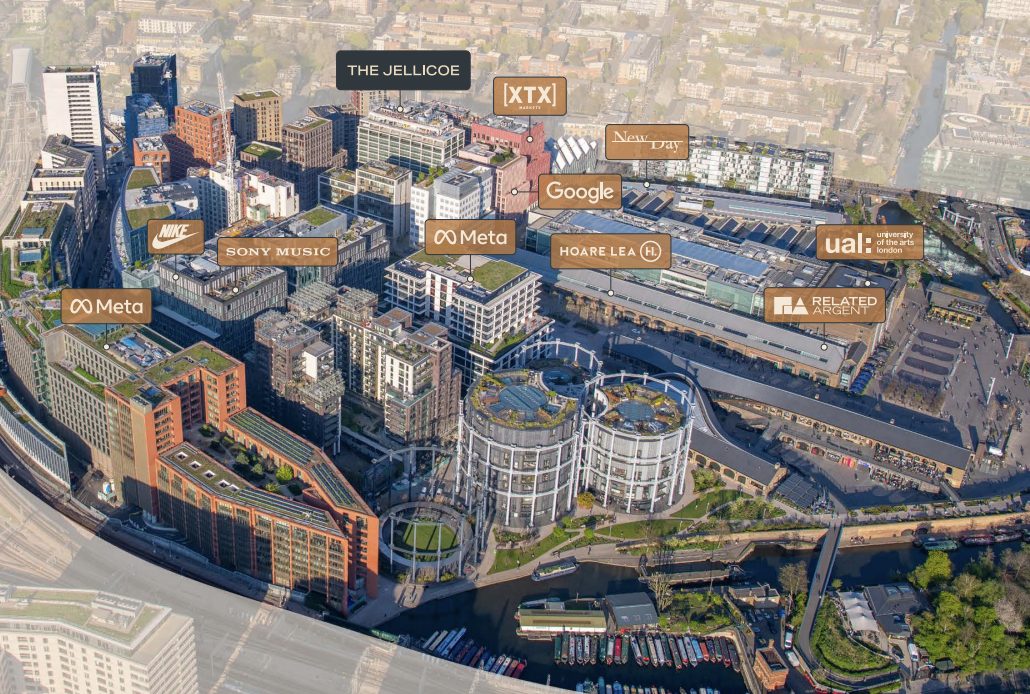
Everyone wants King’s Cross and there is almost no space. A sublease of about 120,000 sq ft was quietly marketed this year and then withdrawn; rumored releases have not materialized; Harvey’s current provider is full in King’s Cross with a waiting list; and the next new scheme (development) behind the current building is not due before about 2030. A list of available space would not help: Harvey will have seen it already, and the conversations that matter with landlords and providers can only happen once someone is authorized to have them on Harvey’s behalf.
Five routes that open once someone can go to market for Harvey.
- Grow within the current provider’s King’s Cross portfolio.A large AI occupier is expected to leave space there when its own building completes. That will be late, and it may keep the space, so this is not a plan on its own.
- A provider consolidates a building for Harvey.Smaller tenants are relocated and Harvey takes the whole building, or the largest space first and the rest as it comes free. Realistic, and it needs the right term length.
- An estate landlord that grows with Harvey.The large estates around Euston and King’s Cross have the churn to add managed floors with rights of first offer, then a bigger building when it comes. This is how other AI occupiers have scaled nearby.
- Start managed, flip to a direct lease.Above about 500 desks the same floors serve every route; what changes is who fits them out. A structure that starts managed and converts to a direct lease at an agreed trigger point can be negotiated.
- Bridge now, anchor later.Keep extending serviced space as the bridge, and pre-commit (pre-lease) to a pipeline development in King’s Cross (due around 2030) as the long-term home. The developers want AI occupiers in those schemes.
Two further options for later: a real-estate investor buying a building on the strength of a five-to-ten-year Harvey lease, and co-investment, where Harvey takes a stake in the asset. Both are down-the-line conversations, noted here so nothing is left off the table.
7 · What happens next
What would make this firm.
- Which comes first: King’s Cross, or room to grow?If King’s Cross is fixed, the routes above are the realistic set. If location can flex, districts with far more supply open up.
- How long Harvey expects to need the space.The decision curve turns on it more than on headcount.
- What the current deal allows.The end date, notice, whether desks can be added and shed month by month, and whether the provider will commit expansion space; it is full today with a waiting list. That is what makes the mixed option work.
- Which headcount is a plan.300, 500 and 700 are what-ifs; one of them should become the planning case.
- If you are willing, the fee.Entering it above sharpens every chart. It is optional; the market figures already frame the answer.
Next: with Harvey’s go-ahead, Resource and our London partners would go straight to the estate landlords and providers who can deliver at this size, test the five routes above, count the remaining lease costs, and come back with a London-wide map of availability and the development pipeline. Talking to landlords or providers needs your sign-off. The model and sources page holds the working model and every input with its source.
Advisory and compensation statusNo appointment or fee arrangement is established by this page
This is a planning discussion, not an instruction to transact or appoint Resource. No Harvey-specific compensation arrangement is evidenced in the supplied material. Any proposed role, payer, fee and differences by option must be disclosed in writing before an appointment or transaction recommendation. This analysis creates no obligation to choose Resource or pursue a transaction.